Why the Boundary Rope Reads So Clearly from the Stands
See why a cricket boundary rope stands out through contrast, repetition and careful placement, and how those choices shape a clear view from the stands.
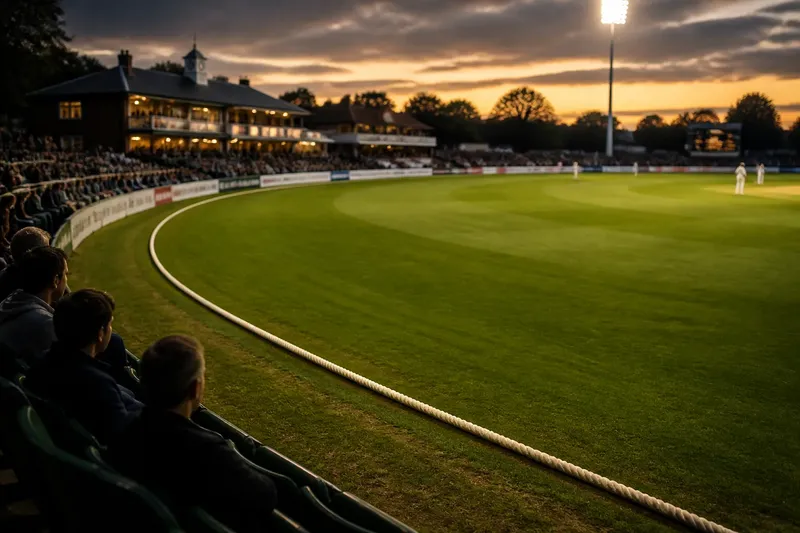
The common mistake is to think a boundary rope is clear simply because it is bright. A rope that blends into the outfield, disappears behind advertising boards or wanders in and out of view can leave spectators unsure where the playing area ends. From the stands, clarity comes from contrast, repetition and placement working together.
One edge, many viewpoints
A boundary rope marks the perimeter used for play, but spectators do not see it from a single, ideal viewpoint. A low seat may place the rope against dark turf; a higher one may make it cross a patch of pale grass, a painted line or the shadow of a stand. The same object can therefore appear crisp from one section and faint from another.
Legibility means that an object can be recognised quickly and consistently. For a rope, that depends less on its colour in isolation than on how its colour differs from the surfaces around it. A light rope can stand out against green grass, yet lose definition beside white advertising or pale ground markings.
The rope also has to be understood as an edge, not merely as a loose object on the grass. Its curve tells the eye where the playing area stops. If that curve is easy to trace, spectators can make sense of catches, boundaries and the space around the field without searching for a separate marker at every point.
Contrast against turf
Contrast is the visible difference between the rope and its background. Colour matters, but so do brightness, texture and the way light falls. A rope that is distinct from freshly cut turf may become less distinct where the outfield is dry, worn or uneven in tone.
Grounds often use a rope colour that separates clearly from the grass, but there is no universal choice that suits every venue. The surrounding scene changes: boundary boards may be light or dark, sunlight may cast a strong shadow, and a bank of seating can create a broad patch of shade. The useful question is not “Which colour is brightest?” but “Does this edge remain easy to follow across the whole view?”
Contrast can also come from shape and texture. A rope with a defined profile may cast a small shadow or create a continuous ridge against the turf. If it lies flat, is partly hidden by grass, or overlaps a similarly coloured line, its outline can weaken even when the material itself is bright.
Repetition makes a boundary
The eye reads a boundary rope as a continuous path because it encounters a repeated visual cue: the same coloured line appearing again and again around the field. This repetition helps the spectator connect one visible section to the next, including when the rope curves away or passes in front of changing backgrounds.
Gaps interrupt that reading. A section hidden by a board, a change in rope thickness or a cluster of equipment can make the perimeter seem to stop and restart. Each interruption asks the eye to infer where the line continues. A few small breaks may not matter from a nearby seat, but repeated breaks can make the overall shape harder to grasp from farther away.
Continuity does not mean every part must look identical in every light. It means the defining cue remains consistent enough to be recognised: a similar colour, a similar height and a visible route. When a ground uses sections joined together, the joins matter because a kink or overlap can look like a change in direction rather than a simple connection.
Placement and the sightline
Placement determines whether the rope can do its visual job. A sightline is the path between a spectator’s eyes and the part of the field they are watching. From some seats, the rope may sit against open grass; from others, its lower edge can merge with a boundary board, a row of advertising or the legs of spectators at the front.
Distance changes how small details appear. From high in a stand, a rope’s texture may disappear, leaving only its overall line and contrast. From a low seat, nearby objects can cover sections of it. This is why a boundary that looks obvious from the middle of the ground can be less legible from a corner or a low, side-on position.
Its position relative to nearby markings matters too. A painted line, drainage edge or strip of worn turf can compete with the rope if the two run close together. The spectator may see both but need an extra moment to decide which one marks the playing boundary. Clear separation between visual cues helps the rope retain its role.
How should grounds judge clarity?
Which rope colour is easiest to see?
There is no single best colour for every ground. Choose a colour that contrasts with the usual turf and nearby boards, then consider how it appears in both sun and shade from different seating areas.
Why can a bright rope still disappear?
Brightness alone cannot overcome an obstructed or competing view. A bright rope may fade against a pale board, a sunlit patch or a similar marking, while a shadow or uneven grass can interrupt its outline.
Does a boundary rope need to be perfectly straight?
No: the boundary often follows a curve, and the rope should make that shape understandable rather than forcing a straight line. What matters visually is a smooth, traceable route without abrupt kinks that look accidental.
What should be checked from the stands?
Look at the rope from more than one height and angle, including a low seat and a corner view. Check whether its route remains visible against changes in grass, boards and shadow, and whether nearby markings create confusion.
A worked viewing example
Say you are helping prepare a small ground where the rope is pale and the boards behind part of the outfield are also pale. From a seat near the centre, the rope looks clear against the grass, but from the corner it seems to vanish where the two light surfaces meet.
The useful response is to consider the whole viewing scene rather than simply choosing a brighter rope. A contrasting rope colour, a clearer gap from the boards, or a change in placement may make the curve easier to follow from that corner. The expected observable result is a more continuous edge, not merely a more noticeable patch of colour.
Exact choices depend on the rope, ground surface and venue arrangements; follow the relevant manufacturer guidance and local ground rules when selecting or positioning equipment. It is not worth trying to make the rope stand out through a collection of extra markers if those additions compete with the boundary itself.
Clarity without sameness
Grounds do not need to look identical for their boundaries to read clearly. An open outfield, a compact venue with close advertising and a ground bordered by deep shade each present a different visual problem. The shared principle is to make the rope’s edge distinct, its path repeatable and its position easy to interpret from the stands.
For anyone considering why a boundary rope reads so clearly, the answer is therefore not a particular colour or a single placement rule. It is the relationship between the rope and everything behind it. A spectator should be able to pick up the line, follow its curve and keep recognising it as the playing boundary, even as the view changes around the ground.